
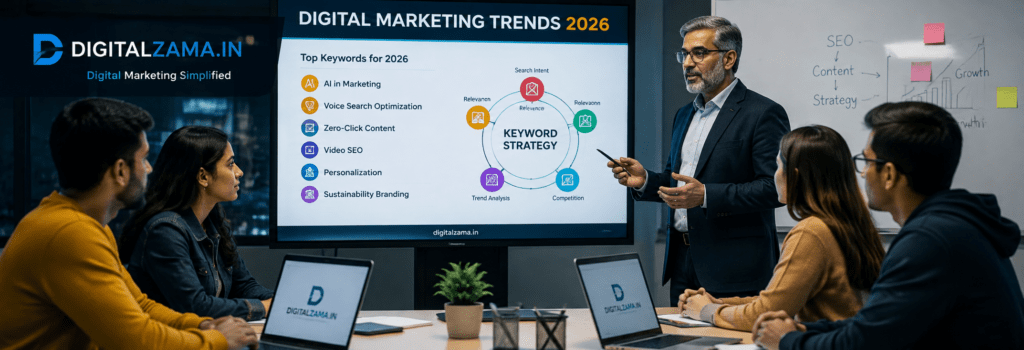
Digital Marketing Trends in 2026
Digital marketing trends in 2026 are being shaped by artificial intelligence (AI), AI-powered search, short-form video, personalization, privacy, and local SEO.
So what should businesses really focus on in terms of digital marketing trends in 2026?
It’s not just about “using more AI”. Consumer behaviour is also changing, especially in how people search, compare businesses, consume content, and make purchasing decisions. So businesses need a digital marketing strategy that brings together technology, useful content, human expertise and a great customer experience.
This guide will take you through the top 10 digital marketing trends for 2026, along with real-world examples and recommendations for businesses.
What Are the Top Digital Marketing Trends for 2026?
- AI-assisted content creation and marketing
- AI-powered search and answer-driven content
- Generative Engine Optimization (GEO)
- First-party data and privacy-first marketing
- Short-form video and creator content
- Personalized marketing
- Local SEO and Google Business Profile optimization
- First-hand experience and expert-led content
- Interactive digital experiences
- Results-oriented marketing
- Businesses don’t have to run after every trend. Which is the best strategy? Depends on the business, audience, industry, budget and marketing goals.
Digital Marketing in 2026: What Is It?
In 2026 digital marketing is about using online channels, data, technology, content and customer knowledge to attract, engage and convert customers.
Now, customers can find a business through Google Search, AI tools, YouTube, social media, reviews, marketplaces and messaging platforms .
For businesses, this means shifting away from individual marketing channels and thinking about the entire customer journey.
Google’s existing guidance also recommends to stay on top of essential SEO practices while creating unique, useful and people-first content for AI-powered search experiences. Google’s guidance on AI features and SEO.
Top 10 Digital Marketing Trends to Watch in 2026
Artificial Intelligence Marketing Goes Mainstream
AI is becoming a handy marketing assistant. Businesses can employ AI for:
Content plans and research
Ad copy variants
Draft emails
Analysis of data
Drafts for Customer Support
Automated Marketing
But content produced by AI shouldn’t be just released without human review. Therefore, Google says AI may be useful for research and content assistance, but creating large amounts of low-value content could violate its spam policies. Google’s advice on AI-generated content.
An SEO agency might use AI to draft a preliminary article outline, then flesh it out with their own campaign experience, examples, data, and expert advice.
DigitalZama recommendation: AI should save time, not replace human expertise.
AI Search and Answer Focus Content
Search is getting more conversational. Users can ask complicated questions and get AI-generated answers alongside traditional search results.
As Google’s AI search features keep evolving, it’s more important than ever for businesses to provide clear answers to real customer questions. Google Search AI documentation
For example, rather than targeting only:
“SEO services”
develop content that also offers answers:
What is the cost of SEO?
How long does SEO take to work?
Can SEO help small businesses?
How local SEO works?
Best practice: Start with the answer first, then explain in detail.
GEO Is Expanding Hand in Hand With SEO
The term ‘Generative Engine Optimization (GEO) describes the actions aimed at optimizing the visibility of a brand in generative AI searches.
Nevertheless, GEO does not supersede SEO.
Google states that its AI-powered search experiences keep depending on Search fundamentals and SEO principles. This means that businesses should concentrate on creating accurate, valuable, original, and structured content, instead of looking for artificial “GEO hacks.” Google AI optimization best practices
Example
Don’t say: Digital marketing is essential for businesses.
Instead, show how the concepts are connected: A local restaurant can apply Google Business Profile optimization, local SEO, customer feedback, social media posts, and paid ads to target people who are actively searching for local restaurants.
This provides additional useful context to search engines and users.
DigitalZama tip: Create solid SEO foundations first, and then make sure your content is clear, credible, and truly valuable.
First Party Data and Privacy First Marketing
Organisations are increasingly focusing on collecting and using first-party data directly from their customers.
Types of first-party data include:
Email subscribers
Purchases
Website visits
Feedback from customers
Form submissions
Activity in loyalty programmes
Example: The company can use previous information about purchases to send emails with product suggestions to particular users rather than sending the same email to all customers.
DigitalZama Recommendation: Establish direct contact with customers through email marketing, CRM, useful forms, surveys, and loyalty programmes
Short-Form Video and Creator Content
Short-form videos are still an important element in educating the audience.
A business may produce videos for:
Demonstrations
Tutorial
FAQs
Tips from experts
Customer Stories
Behind-the-scenes content
Example: A digital marketing agency may produce a 30-second video with the question:
“Why is my website not ranking in Google?”
The video may contain a single tip and encourage viewers to find out more.
It shouldn’t be done just because short videos are trendy, each video should educate, demonstrate, entertain, give an answer to a question or establish trust.
Personalization is Becoming More Important
Customers react better when the marketing is tailored to them.
Businesses may personalize experiences with:
Location
Previous purchases
Website interaction
Customer interests
Previous conversations
Example: A travel site can display budget travel content to a person looking for inexpensive trips and luxury travel packages to a person researching luxury travel.
Personalization doesn’t always have to involve advanced use of artificial intelligence technology. Relevance in email campaigns and landing pages is sufficient to enhance user experience.
Local SEO is Essential for Local Businesses
For businesses that provide their services at a certain location, Local SEO can be one of the most tangible digital marketing strategies.
Key aspects:
* Google Business Profile
*Local keywords
* Customer reviews
* Location pages
* Local content
* Local links
* Business info
Example: A digital marketing company based in Noida may produce really valuable content on the following topic:
“Local SEO Tips for Small Businesses in Noida”
instead of adding “Noida” to its general article again and again.
DigitalZama’s tip: Local companies should focus on Google Business Profile + Local SEO + reviews + local content.
First-Hand Experience and Expert Content
One of the main issues on the internet is content duplication. There is a large number of websites publishing very similar articles on a variety of topics.
To make your content unique, you should demonstrate your expertise by means of:
* Case studies
*Original research
* Screenshots
*Examples
* First-hand experiences
* Opinions of experts
* Processes
In Google’s people-first content guidelines, the company pays special attention to creating useful, reliable content that adds value to users. Google helpful content guidance.
DigitalZama recommendation: Prior to publishing your content piece, ask:
“What is the useful information that we are delivering which other articles have not delivered effectively enough?”
Interactive and Useful Content
* Besides just writing a blog post, organizations could explore using interactive forms like:
* Calculators
* Quizzes
* Checklists
* Templates
* Comparison tables
* Assessments
Example: The digital marketing agency could develop a “Digital Marketing Budget Calculator” which will help companies start from somewhere depending on their industry, goals, and budget.
So these types of useful tools can be more beneficial for organisations than a regular old 1,500-word article.
Marketing Measurement Is Not About Vanity Metrics
Traffic and likes can be useful; however, it does not necessarily mean business success.
In addition to these, organizations must measure:
* Number of qualified leads
* Sales
* Conversion rate
* Customer acquisition cost
* Revenue
* Return on ad spend
* Organic traffic
* Conversions
For instance, an article which got 1,000 visitors and 50 qualified leads would be more beneficial than one which received 10,000 visitors and only two qualified leads.
Note* DigitalZama recommendation: Do not only ask, “How many visitors did we get?” Ask, “Was the traffic able to contribute towards achieving our business objectives?”
Digital Marketing Trends in India 2026
India remains one of the largest digital markets. According to the Data Reportal, India was expected to have approximately 1.03 billion Internet users by the end of 2025 with an internet penetration of approximately 70%. Digital 2026: India
Opportunities worth taking advantage of:
Regional language content
Companies can increase their outreach through helpful regional language content in Hindi, Tamil, Telugu, Bengali, Marathi, and many others.
Mobile-first experience
The website should be quick to load, mobile-friendly and have easy navigation and form fields.
Conversational marketing
Businesses can leverage messaging for customer inquiries, appointments, updates and other support using the consent of users.
Local campaigns
Using digital marketing combined with local culture, local festivities, languages and preferences of customers can create more relevant campaigns.
SEO vs AEO vs GEO
Strategy Goal Description
SEO visibility optimisation Appearing in “SEO services” rankings
AEO Best answer optimisation Best answer for “What is local SEO”
GEO Generative AI visibility optimisation Concise, clear, and authoritative content
These strategies are not entirely mutually exclusive.
SEO fundamentals, helpful and valuable content, expertise, technical quality and answers can give visibility on both traditional and AI-driven search engines.
Which Trends Should Small Businesses Prioritize?
Business Type Strategy
Local business Local SEO, Google Business Profile and Reviews
Restaurant Local SEO, Reviews and Videos
E-commerce SEO, product content and social media
B2B companies Expert content, SEO and lead generation
Startups SEO, content and social media
Services business Local SEO, content and conversion optimization
For most small businesses, start with SEO foundations, useful content, local SEO where relevant, video where appropriate, and conversion tracking.
FAQ for Digital Marketing Trends 2026
1) What are the biggest digital marketing trends for 2026?
The biggest trends include AI-assisted marketing, AI-powered search, GEO, first-party data, short-form video, personalization, local SEO, expert-led content, interactive experiences, and performance measurement .
2) Does SEO matter in 2026?
Yes. SEO still matters in 2026. Google’s guidance on AI search confirms that core SEO practices remain relevant for AI-powered Search experiences. Google Search Tips
3) What is Expected Outage?
Answer Engine Optimization (AEO) is the creation of content that directly answers questions that people may ask in search and answer-centric experiences.
4) What is GEO?
GEO, or Generative Engine Optimization, refers to efforts to improve visibility in generative AI search experiences. It should complement, not replace SEO.
Using AI for small businesses
Artificial intelligence can be used by small businesses for research, content ideas, customer support drafts, data analysis, automation and creative brainstorming. Human review is still important for accuracy and expertise.
5) What is the biggest digital marketing trend for small businesses?
There isn’t a universally applicable trend. For many local businesses, great places to start are Local SEO, Google Business Profile optimization, reviews, helpful content, and conversion-focused website improvements.
Conclusion for digital marketing trends 2026
The biggest takeaway from the digital marketing trends of 2026 is that technology is changing quickly but the fundamentals of effective marketing still count.
So, customers want useful information, trusted businesses, simple experiences, and real solutions.
AI is able to speed up marketers’ work. Search is increasingly conversational. Video is changing the way people discover brands. First-party data is more valuable.
But don’t chase every trend.
Begin with your customers. Create content that is helpful. Establish your SEO foundation. Show real expertise. Measure business outcomes. Then deploy new technology where it truly enhances the customer experience.
Our advice at DigitalZama? Make marketing smarter with tech, but remember to put people, usefulness, trust and business results at the heart of your strategy.